Importance of Digital Inventory Management
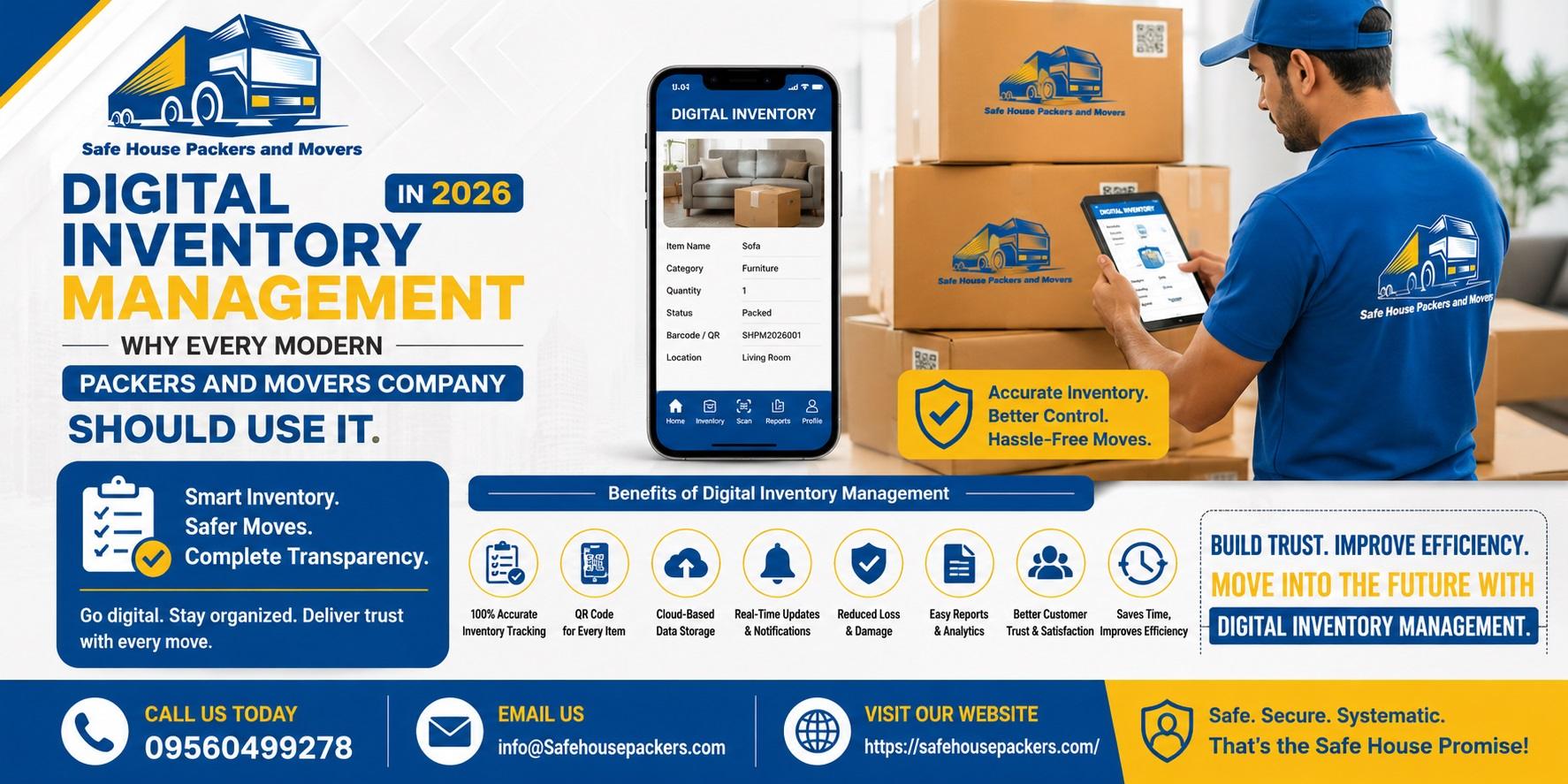
Think about the last time you shifted homes. Somewhere between wrapping the mixer grinder in old newspaper and counting cartons for the tenth time, you probably thought, "There has to be an easier way to keep track of all this." You are not wrong. And this is exactly the problem digital inventory management solves for packers and movers companies today.
If you have ever moved house in India, you know the drill. A supervisor walks around your home with a pen and a clipboard, scribbling down item names on paper. By the time the truck reaches your new address, half the sheet is smudged, a few items are missing from the list, and nobody remembers what colour box the crockery went into. This old system is slow, messy, and honestly, a bit outdated for 2026.
That is why more and more moving companies are switching to digital inventory management. It is not just a fancy add-on. It is quickly becoming the backbone of how a professional relocation business runs.
What Exactly Is Digital Inventory Management?
In simple words, digital inventory management means using an app, software, or a digital system to record, track, and manage every single item that goes into a move. Instead of paper lists, the packing team uses a tablet or phone to log each item, tag it with a barcode or QR code, click a photo, and note its condition before loading.
The customer gets a digital copy of this list. The company gets real-time visibility of where every box is. And nobody has to squint at handwriting to figure out what "kitchen stuff" meant.
Why the Old Pen-and-Paper Method Is No Longer Enough
Paper lists get lost. Ink smudges. Handwriting is not always clear. And when a customer calls asking "where is my washing machine," a manual system means someone has to physically call the driver, wait for a reply, and hope the truck supervisor remembers.
This is not a small inconvenience anymore. India's relocation and logistics demand is growing fast, and companies that still rely on outdated tracking are simply going to fall behind.
1. India Is a Country on the Move
People in India change cities and homes more often than you might think. As per Census data, India had 45.6 crore internal migrants, which is close to <cite index="14-1,14-2">38% of the population in 2011, and this number grew by 45% between 2001 and 2011</cite>, a much faster pace than population growth itself, which rose by only 18% in the same period. You can check the detailed breakdown on PRS India.
More recent government data backs this up too. According to the Periodic Labour Force Survey, <cite index="12-1">the total migration rate in India stood at 28.9%, with rural migration at 26.5%</cite>, as reported by the Press Information Bureau. That is a massive number of households packing up boxes every single year. And every single one of those moves needs proper tracking so nothing gets lost or damaged along the way.
2. Everyone Is Online, So Everyone Expects a Digital Experience
Gone are the days when customers were fine with a phone call and a paper receipt. As per TRAI's own data, internet subscribers in India crossed 102.86 crore by December 2025, and broadband users have crossed the 1 billion mark, according to a report shared by the Telecom Regulatory Authority of India through PIB. With that many people online and used to tracking their food delivery or cab in real time, they naturally expect the same when their entire household is being shifted across the city or country.
A company that still hands over a torn paper list at the end of a move looks out of touch. A company that sends a digital inventory sheet with photos and item counts on WhatsApp or email looks professional and trustworthy.
3. The Logistics Industry Itself Is Booming
India's logistics sector is not a small, unorganised space anymore. The India logistics market reached close to USD 427 billion in recent estimates and continues to grow at a steady pace year after year, as tracked by IMARC Group's market research. Within this, third-party logistics providers, the kind of organised, tech-driven companies that use proper inventory systems, now hold the largest share of the model type segment, close to 48%, according to the same report.
Packers and movers fall under this larger logistics umbrella, and customers are increasingly comparing moving companies to the same standard they see in modern courier and freight services. A brand that wants to stand out, like Safe House Packers and Movers Sonipat, has to match that same level of professionalism, which starts with proper digital record-keeping.
4. Damage Disputes Are Common, and Proof Matters
Let's be honest, damage during a move is one of the most common complaints customers have. A scratched dining table or a broken television is not just an inconvenience; it becomes a dispute about who is responsible. This is where digital inventory management genuinely saves the day.
When every item is photographed and logged with its condition before loading, there is a clear record. If something goes wrong, there is proof of the item's state before the move started. This protects both the customer and the company from unnecessary arguments.
Insurance also plays a role here. India's overall insurance penetration stood at just 3.7% of GDP in the 2024-25 financial year, with non-life insurance penetration remaining flat at only 1%, as noted in the IRDAI annual report shared through PIB. This means most Indian households are underinsured, which makes proper documentation during a move even more important. A digital record can support any insurance claim far better than a handwritten note ever could.
5. E-Commerce Habits Have Changed What People Expect from Services
India's e-commerce logistics market is projected to grow from around USD 6.65 billion to over USD 11 billion by 2031, growing at a CAGR of close to 9%, as per Mordor Intelligence's market analysis. People who order groceries, furniture, and electronics online are used to tracking numbers, delivery updates, and digital receipts. When these same customers hire a moving company, they naturally expect a similar experience, not a return to pen and paper.
How Digital Inventory Management Actually Works
For those wondering how this looks in practice, here is a simple breakdown:
- Item Listing: Every item is entered into the system, either by scanning a barcode sticker or typing it manually into an app.
- Photo Documentation: A photo of each item, or at least each box, is taken before packing to record its condition.
- Digital Tagging: Items get a unique code so they can be tracked from the old home to the truck to the new home.
- Real-Time Updates: The customer can check the status of their belongings, sometimes even track the truck's location.
- Digital Handover: At delivery, the same digital list is used to confirm every item has arrived, with the customer signing off electronically.
This process removes guesswork completely. There is no confusion about missing boxes, no arguments over what was or was not packed, and no lost paperwork.
Benefits for the Customer
For the person moving house, the biggest benefit is peace of mind. You know exactly what has been packed, you have proof of the condition of your belongings, and you are not depending on someone's memory or handwriting. If a query comes up, you can look at your phone instead of digging through old papers.
It also saves time. Instead of manually cross-checking every box at delivery, the digital list does the counting for you.
Benefits for the Moving Company
For the business itself, digital inventory management reduces disputes, builds trust, and creates a professional image. It also helps internally: supervisors can plan truck loading better, managers can track multiple moves happening at once, and customer support teams can answer questions quickly without waiting for updates from the field.
This is exactly why Safe House Packers and Movers has been moving toward digital tracking methods for its operations. When a company like Safe House Packers and Movers Sohna shows a customer a clean digital inventory sheet instead of a crumpled paper list, it builds instant confidence.
A Small Investment That Pays Off Big
Setting up digital inventory tools does require some initial investment, whether it is a simple app, barcode printers, or training staff to use tablets instead of notebooks. But given how fast India's logistics and relocation demand is growing, this is not really optional anymore. It is quickly becoming the standard customers expect.
Companies that adapt early will naturally attract more customers simply because they offer a smoother, more transparent moving experience. Companies that stick to old paper-based systems risk losing business to competitors who can offer proof, tracking, and accountability.
Final Thoughts
Moving homes is stressful enough without worrying about a missing box or a damaged item with no proof of its original condition. Digital inventory management fixes this problem at its root. It gives customers confidence, gives companies better control over operations, and reflects the direction India's entire logistics industry is heading toward.
Whether you are a homeowner planning your next move or a business owner running a packing and moving company, digital inventory tracking is worth paying attention to. It is simple, it works, and it is quickly becoming the new normal.
So the next time you are comparing moving companies, ask if they offer digital inventory tracking. If the answer is yes, you are likely dealing with a team that takes accountability seriously, the same way Safe House Packers and Movers Panipat does for every household it helps relocate.
