AI and Logistics: How Smart Technology Is Revolutionising Relocation Services
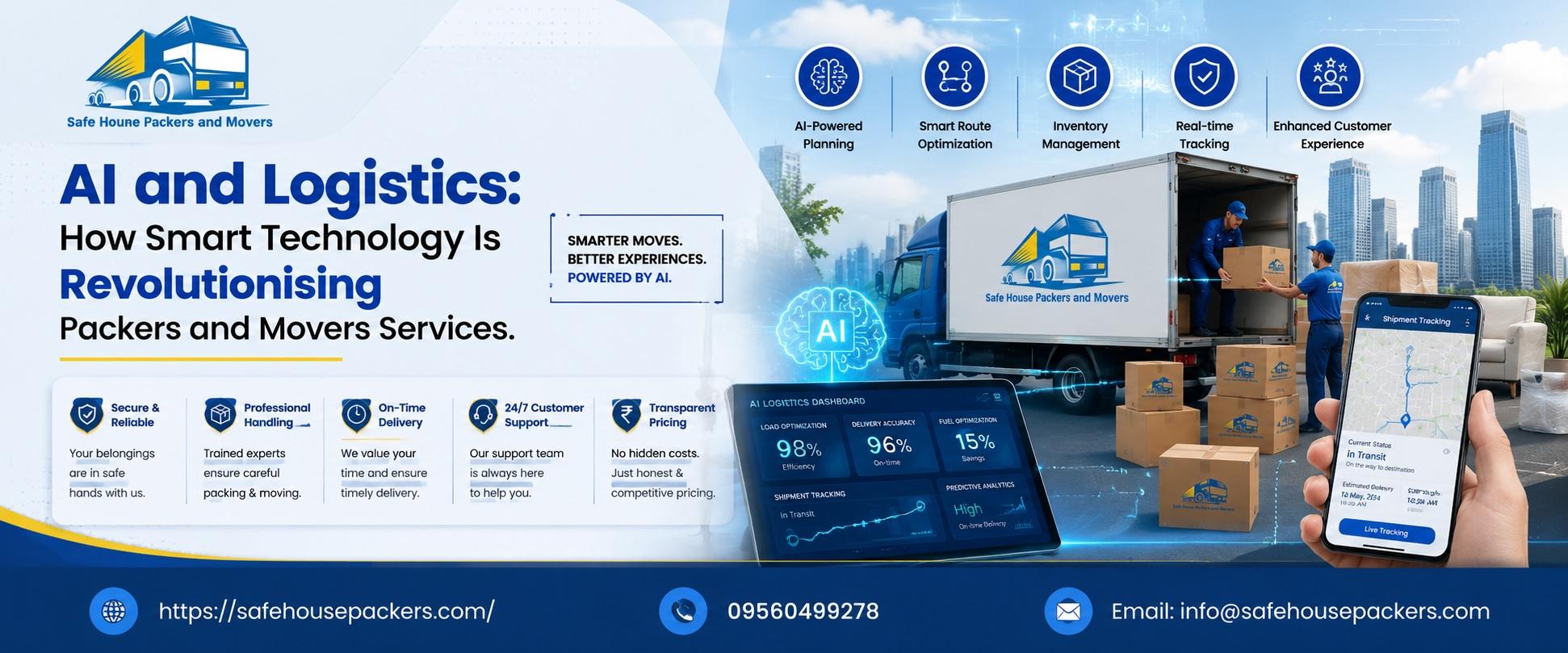
Earlier, moving from one house to another, or shifting an office to a new city, used to mean one thing — stress. Boxes everywhere, missing items, late trucks, and that constant worry about whether your favourite mirror will reach in one piece. But things are changing fast. Technology, especially Artificial Intelligence (AI), is quietly stepping into the packing and moving world and making it smarter, faster, and far less painful.
This blog will walk you through how AI is changing the packers and movers industry in India, why this matters for you, and what numbers tell us about this shift. We will also talk about how companies like Safe House Packers and Movers are using these tools to give customers a better, more reliable shifting experience.
Why the Moving Industry Needed a Tech Upgrade
For decades, packing and moving in India was run almost entirely on manual labour, paper records, and guesswork. A supervisor would estimate how many boxes you need, a driver would pick a route based on instinct, and if something went missing, there was no way to track it.
This old system had real costs. India's logistics sector has historically struggled with high costs and poor visibility across the supply chain. Studies suggest that India's logistics cost stands at around eight per cent of the country's GDP, and even though this has come down from earlier estimates of thirteen to fourteen per cent, it still adds up to a massive amount of money spent every year, much of it lost to inefficiency, source: Journal of Supply Chain.
This is exactly where AI comes in. It does not just speed things up — it removes the guesswork that caused so many of these losses in the first place.
The Size of the Opportunity
The numbers around AI in India's logistics space are genuinely surprising. The Indian AI in logistics market is projected to grow at a CAGR of 31.66 per cent between FY2025 and FY2032, rising from around USD 756 million in FY2024 to nearly USD 6,829 million by FY2032, according to data shared by MarketsandData. That is not a small jump — it shows that logistics companies across India, including smaller regional movers, are investing heavily in smart systems.
On a broader scale, the Indian AI in the supply chain market itself is growing at a CAGR of 37.80 per cent through 2032, as reported by MarketsandMarkets. When an entire ecosystem grows this fast, packers and movers companies cannot afford to stay old-fashioned.
How AI Is Actually Changing Packing and Moving Services
Smarter Route Planning, Less Time on the Road
One of the biggest headaches in moving is the delay. Trucks stuck in traffic, wrong routes, fuel wasted — all of it adds up. AI-powered route optimisation tools now study live traffic, weather, and road conditions to pick the fastest path for your truck.
AI route optimisation systems process real-time traffic data, weather conditions, vehicle capacity, delivery time windows, and driver availability to work out the best possible route, as explained by Optivus Technologies. For a company like Safe House Packers and Movers, this means your goods reach your new home or office faster and with fewer surprises.
Predicting Demand Before It Happens
Ever wondered how a moving company knows how many trucks, packers, and boxes to keep ready during peak season? AI-based demand forecasting is the answer. AI can improve demand forecasting accuracy by up to fifty per cent and reduce overall logistics costs by nearly fifteen per cent, according to MarketsandMarkets. This means fewer last-minute shortages of manpower or vehicles when you book your move.
Warehousing That Thinks for Itself
Many movers store your belongings temporarily before final delivery, especially during long-distance or international relocations. Mahindra Logistics has used robotic picking systems to push order accuracy up to 99.2 per cent in its warehouses, as noted by Mordor Intelligence. This same kind of robotics and smart shelving is slowly entering the packing and storage side of the moving business, too, reducing the chances of your boxes getting lost or mixed up with someone else's shipment.
Real-Time Tracking for Peace of Mind
Gone are the days when you would call the moving company five times a day asking, "Where is my truck now?" Real-time tracking, powered by AI and IoT sensors, lets you see exactly where your shipment is on a map, at any hour. This single feature has probably done more to build trust between customers and movers than anything else in recent years.
Reducing Errors and Failed Deliveries
One area where AI has made a quiet but powerful difference is predicting which deliveries are likely to fail or get returned. An AI-powered tool built by Delhivery has helped over 4,800 e-commerce businesses cut return shipments, especially for cash-on-delivery orders, which make up more than sixty per cent of e-commerce transactions in India, reducing returns by up to twenty per cent, as reported by Markets and Data. While this example is from e-commerce, the same prediction logic is now being adapted by packers and movers to avoid wasted trips, wrong addresses, and rescheduling chaos.
What This Means for the Common Indian Household or Office
Lower Costs Over Time
When a moving company wastes less fuel, makes fewer wrong trips, and uses warehouse space efficiently, the savings eventually reach the customer, too. AI-based logistics solutions can cut emissions by ten to fifteen per cent through better route planning, according to MarketsandMarkets — and less fuel burned generally translates to more competitive pricing for households and businesses booking a move.
Faster, More Reliable Shifting
Globally, 87 per cent of enterprises now use AI for demand forecasting, leading to over a 35 per cent improvement in forecasting accuracy, while 67 per cent report a 28 per cent drop in stockouts through AI-based inventory management, according to data shared by All About AI. For packers and movers, this kind of forecasting means better planning of manpower and vehicles, so your moving date does not get delayed because "the truck is busy."
A Bigger, More Organised Industry
India's logistics backbone is also getting stronger, which directly benefits movers. India has jumped to the 38th position in the World Bank's Logistics Performance Index in 2023, up from 44th in 2018, as highlighted by 3SC Solution. This jump reflects better infrastructure, digital customs processing, and overall efficiency — all of which trickle down to faster, smoother household and office relocations.
A Growing, Job-Creating Sector
This shift is not just about machines replacing people. India's logistics industry is supported by a vast workforce of 22 million people across local players, global firms, government services, and new-age startups, according to 3SC Solution. AI tools are mainly helping this workforce work smarter — handling the planning and prediction, while skilled packers, drivers, and supervisors still do the hands-on work of treating your belongings with care.
Safe House Packers and Movers: Bringing Smart Technology to Everyday Shifting
This is where companies like Safe House Packers and Movers Greater Kailash fit into the bigger picture. As AI tools become more accessible, even mid-sized and regional moving companies are beginning to use smart scheduling, route planning, and tracking systems to serve customers better. Safe House Packers and Movers Dwarka represents the kind of service provider that blends traditional packing expertise — careful wrapping, safe loading, trained staff — with the newer layer of technology that keeps customers informed and reduces last-minute surprises.
Whether you are shifting a two-bedroom home across the city or relocating an entire office to another state, working with a team like Safe House Packers and Movers Kirti Nagar that understands both the human side of moving and the tech side of logistics can make the entire experience far less stressful.
A Few Challenges That Still Need Work
It is worth being honest here — AI in Indian logistics is still maturing. Algorithms need accurate data to work correctly, cybersecurity threats can disrupt operations, workers need training on new tools, and infrastructure in some areas may not yet support advanced automation, as pointed out by AWL India. So while the direction is clearly positive, it will take a few more years before every packer and mover, big or small, has full access to these tools.
The Road Ahead
The shift from manual, guesswork-based moving to data-driven, AI-assisted relocation services is already underway in India. With logistics hubs expanding beyond metro cities, AI adoption is expected to spread into smaller towns too, opening up new opportunities for regional movers, as observed by MarketsandMarkets.
For the customer, this simply means one thing: moving day is slowly becoming less of a nightmare and more of a well-planned, tracked, and predictable event. And as more companies, from large logistics players to focused regional names like Safe House Packers and Movers, bring these tools into their everyday operations, the entire packing and moving experience in India is set to become smarter, safer, and a lot more peaceful for everyone involved.
